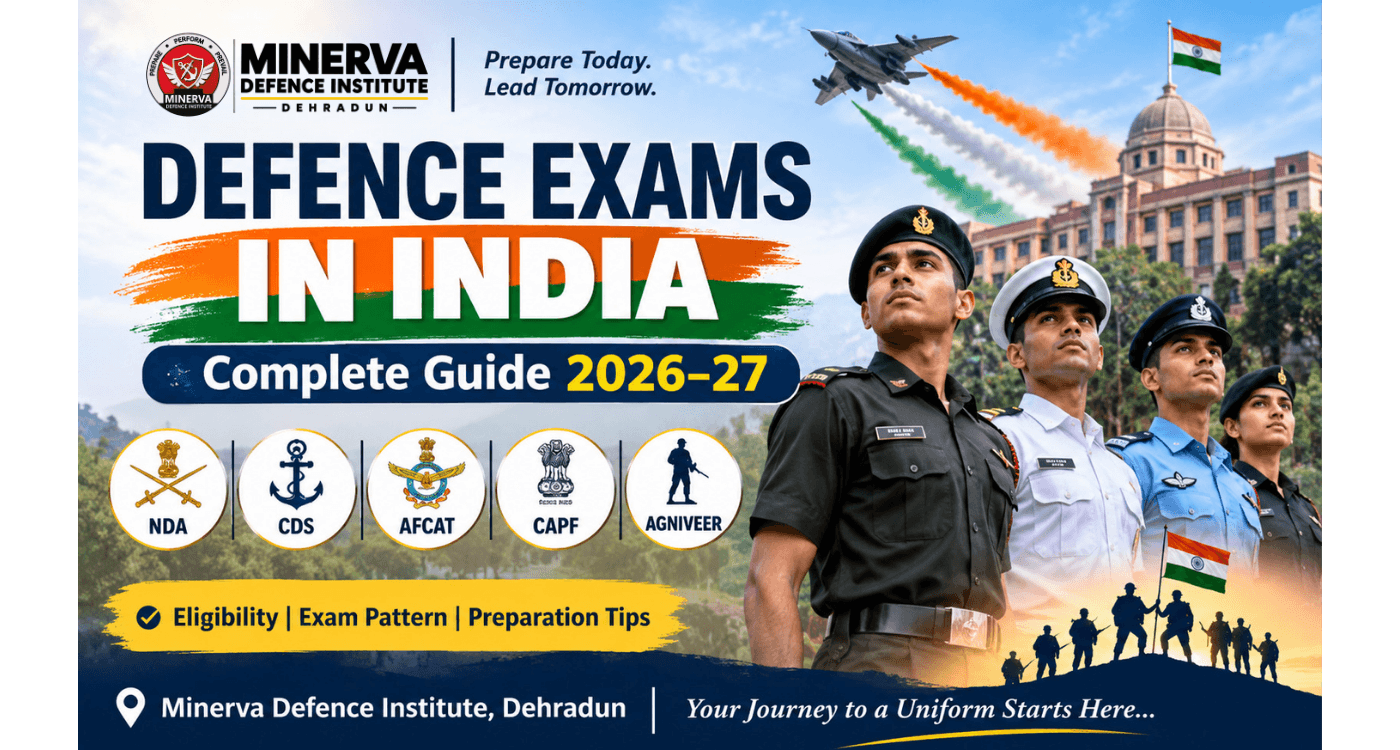
Defence Exams in India: Complete Guide to NDA, CDS, AFCAT & More
Every year, lakhs of young Indians aspire to wear the uniform and serve the nation. Some have dreamed of joining the defence forces since childhood, while others make this decision during Class 12 or graduation.
However, the first step towards achieving this dream is understanding which entrance examination leads to which career opportunity.
At Minerva Defence Institute, Dehradun, we understand that defence aspirants often have questions about eligibility, examination patterns, selection procedures and preparation strategies. This guide explains the major defence entrance examinations in India and helps you understand the available career pathways.
Start With Your Qualification
Different defence examinations are designed for candidates at different educational levels.
After Class 12: NDA, Agniveer and other eligible Army, Navy and Air Force recruitment entries.
After Graduation: CDS, AFCAT, CAPF (Assistant Commandant) and various technical entries.
Before Class 9: Sainik School and RIMC entrance examinations.
Understanding your eligibility helps you select the right examination and plan your preparation accordingly.
1. NDA (National Defence Academy)
The National Defence Academy (NDA) examination is conducted by UPSC twice a year. It is one of the most popular entry routes for students who want to become commissioned officers in the Indian Armed Forces.
Selected candidates undergo training at the National Defence Academy in Khadakwasla, Pune, before proceeding to their respective service academies.
NDA Eligibility
Candidates must be unmarried.
Generally, the age requirement is between 16.5 and 19.5 years, subject to the official notification.
Army Wing: Class 12 pass or appearing from any stream.
Air Force and Naval Wings: Class 12 with Physics and Mathematics.
Candidates must satisfy the prescribed physical and medical standards.
NDA Written Examination Pattern
The written examination consists of two papers:
Mathematics: 300 Marks
General Ability Test (GAT): 600 Marks
After qualifying in the written examination, candidates proceed to the SSB interview, medical examination and final merit process.
Starting NDA preparation during Class 11 or 12 can help students build a strong foundation in Mathematics, English, General Knowledge and personality development.
2. CDS (Combined Defence Services)
The Combined Defence Services (CDS) examination is conducted by UPSC for graduates who aspire to become commissioned officers in the Indian Armed Forces.
Through CDS, candidates can apply for entry into:
Indian Military Academy (IMA)
Indian Naval Academy (INA)
Air Force Academy (AFA)
Officers Training Academy (OTA)
Dehradun is home to the prestigious Indian Military Academy (IMA), making defence careers especially inspiring for local aspirants.
CDS Eligibility
Candidates must hold a recognised graduation degree.
IMA and OTA generally accept graduates from any discipline.
INA requires an engineering degree.
AFA generally requires a degree with Physics and Mathematics at Class 12 level or a Bachelor of Engineering.
Age limits and other conditions vary according to the academy and notification.
CDS Written Examination Pattern
For IMA, INA and AFA:
English
General Knowledge
Elementary Mathematics
For OTA:
English
General Knowledge
Candidates who qualify in the written examination are called for the SSB interview and subsequent medical and merit procedures.
3. AFCAT (Air Force Common Admission Test)
The AFCAT examination is conducted by the Indian Air Force to recruit candidates for its Flying Branch and Ground Duty branches, subject to available vacancies and eligibility conditions.
It offers an opportunity for eligible graduates to pursue a professional career in the Indian Air Force.
AFCAT Examination Pattern
The examination generally covers:
General Awareness
Verbal Ability in English
Numerical Ability
Reasoning
Military Aptitude
Candidates applying for the Flying Branch must also meet additional eligibility requirements and undergo the prescribed selection assessments, including the Pilot Aptitude Battery Test where applicable.
The selection process includes the written examination, AFSB assessment, medical examination and final merit list.
4. CAPF (Assistant Commandant)
The Central Armed Police Forces (CAPF) Assistant Commandant examination is conducted by UPSC for recruitment into various central armed police forces.
These include:
Border Security Force (BSF)
Central Reserve Police Force (CRPF)
Central Industrial Security Force (CISF)
Indo-Tibetan Border Police (ITBP)
Sashastra Seema Bal (SSB)
CAPF Eligibility
Candidates must hold a recognised bachelor's degree.
Age limits and relaxation provisions are specified in the official notification.
Candidates must meet the prescribed physical and medical standards.
CAPF Examination Pattern
The selection process includes:
Paper I: General Ability and Intelligence (Objective).
Paper II: General Studies, Essay and Comprehension (Descriptive).
Physical Standards and Physical Efficiency Tests.
Interview or Personality Test.
Medical Examination.
CAPF provides an opportunity to serve the country in a leadership role within India's central armed police forces.
5. Agniveer Recruitment
Under the Agnipath Scheme, eligible candidates are recruited as Agniveers into the Indian Army, Indian Navy and Indian Air Force.
The engagement period is four years, including training. At the end of this period, up to 25% of a batch may be selected for regular service, subject to organisational requirements and applicable selection criteria.
Agniveer Eligibility
Age eligibility is generally between 17.5 and 21 years, subject to the applicable recruitment notification.
Educational qualifications vary according to the service and trade.
Candidates must satisfy prescribed physical and medical standards.
Agniveer Selection Process
The selection process may include:
Online Common Entrance Examination.
Physical Fitness Test.
Physical Measurement Test, where applicable.
Adaptability Tests, where applicable.
Medical Examination.
Final merit list.
Candidates should always check the latest official recruitment notification for updated eligibility and selection requirements.
6. Sainik School Entrance Examination (AISSEE)
The All India Sainik Schools Entrance Examination (AISSEE) is conducted for admission to eligible classes in Sainik Schools across India.
Sainik Schools aim to provide quality education and prepare students for future opportunities, including careers in the Armed Forces.
Admission Details
Admission is generally offered for Class 6 and Class 9.
Candidates must meet the prescribed age criteria.
Selection is based on the entrance examination and subsequent admission requirements.
Early preparation in Mathematics, Intelligence, Language and General Knowledge can help students build a strong academic foundation.
7. RIMC Entrance Examination
The Rashtriya Indian Military College (RIMC) is a prestigious institution that prepares young students for future careers in the Armed Forces.
Admission is offered to eligible students through a competitive entrance examination.
RIMC Eligibility
Admission is generally offered to boys and girls studying in or having passed Class 7, subject to the prescribed conditions.
Candidates must meet the age criteria mentioned in the official notification.
Selection involves a written examination, interview and medical examination.
RIMC provides a structured educational environment focused on academic development, discipline and leadership.
8. Understanding the SSB Interview
The Services Selection Board (SSB) Interview is an important stage in the selection process for many officer-level entries in the Indian Armed Forces.
It evaluates a candidate's personality, leadership qualities, communication skills, decision-making ability and suitability for a career as an officer.
SSB Interview: Five-Day Selection Process
Day 1: Screening Test
Officer Intelligence Rating Test.
Picture Perception and Description Test.
Days 2–4: Psychological and Group Testing
Psychological Tests.
Group Testing Officer Tasks.
Personal Interview.
Group Discussions and other assessment activities.
Day 5: Conference
Final assessment and discussion by the selection board.
Recommendation decision.
SSB preparation is not about memorising answers or following shortcuts. Candidates should focus on self-awareness, communication, confidence, teamwork and consistent personal development.
9. How to Prepare for Defence Exams: Practical Tips
Preparing for defence examinations requires consistency, discipline and a well-planned strategy.
Here are some useful preparation tips for aspirants:
1. Understand the Official Notification
Always read the latest examination notification to understand eligibility, age limits, vacancies, examination dates and selection procedures.
2. Strengthen Mathematics and English
Build a strong foundation in Mathematics, English grammar, vocabulary and comprehension, especially for NDA and CDS examinations.
3. Develop General Knowledge
Read newspapers regularly and stay updated with national news, international developments, history, geography, science and current affairs.
4. Maintain Physical Fitness
Develop a healthy and consistent fitness routine to prepare for physical assessments. Follow the prescribed standards for your selected entry.
5. Improve Communication Skills
Practise speaking clearly, expressing your opinions and participating in group discussions.
6. Attempt Regular Mock Tests
Mock tests help you understand the examination pattern, improve time management and identify areas that require improvement.
7. Start SSB Preparation Early
Work on communication, teamwork, confidence and personality development rather than waiting until the written examination results.
10. Common Mistakes Defence Aspirants Should Avoid
Many candidates face difficulties because of avoidable preparation mistakes.
Some common mistakes include:
Preparing for only one examination without exploring other eligible opportunities.
Ignoring medical and physical eligibility requirements.
Starting SSB preparation only after clearing the written examination.
Following someone else's preparation strategy without understanding individual strengths and weaknesses.
Avoiding mock tests and regular practice.
Giving up after an unsuccessful attempt instead of analysing areas for improvement.
A disciplined preparation strategy and consistent guidance can make the journey more organised.
11. Why Choose Minerva Defence Institute, Dehradun?
Choosing the right defence coaching institute can help aspirants build a strong academic foundation and prepare systematically for competitive examinations.
Minerva Defence Institute, Dehradun, provides guidance and coaching for major defence entrance examinations, helping students understand their career options and prepare with a structured approach.